
Panniculectomy removes an overhanging apron of lower abdominal skin and fat. It can address the tissue involved in persistent skin-fold problems or appearance concerns, but it does not automatically include tightening the abdominal muscles. The useful first decision is whether your main problem is the hanging fold, abdominal wall laxity, a suspected hernia, or several separate concerns. An examination must establish that distinction before a procedure or coverage request is chosen. ASPS procedure overview
The name alone tells you too little about the planned operation. Ask for a drawing of the intended tissue removal, an explanation of what happens to the navel, and a written list of any additional abdominal procedures. Keep the clinical plan, financial quote and coverage decision together, but give each its own document. Agreement on one does not establish the other two.
What a panniculectomy changes
The pannus is the hanging lower abdominal tissue being assessed. ASPS describes a panniculectomy as removing that excess skin and fat; unlike a tummy tuck, muscle tightening is typically absent. The society also explains that substantial subsequent weight changes can affect the result, and that stretch marks outside the removed tissue will remain. This is not a weight-loss treatment. ASPS scope and limitations
Translate those boundaries into a practical goal. Someone whose main difficulty is managing a hanging fold should describe the fold and its effect on daily life. Someone seeking a narrower waist, improved upper abdominal contour or a change in muscle separation should name those goals separately. They may lead to additional evaluation or a different proposal. A photograph of the abdomen does not by itself establish which underlying structure is responsible.
Separate tissue removal from abdominal wall work
Write down the actual operation being proposed rather than using panniculectomy and abdominoplasty interchangeably. If the plan includes both, ask which portion addresses your functional concern and which portion addresses another goal. If a hernia repair is proposed, identify that repair separately, including the responsible surgical team and follow-up arrangements. This makes the consent and quote easier to understand without trying to decide surgical technique yourself.
| Concern to describe | Distinction to establish | Record to request |
|---|---|---|
| Hanging lower abdominal fold | Exact tissue targeted for removal | Marked diagram and procedure name |
| Upper abdominal or waist contour | Whether additional contouring is proposed | Separate scope and cost entry |
| Muscle separation or wall laxity | Whether wall tightening is included | Explicit inclusion or exclusion |
| Suspected hernia | Diagnosis and separate repair plan | Examination findings and responsible team |
| Stretch marks or old scars | Which are inside the removal area | Realistic retained-skin and scar explanation |
The table is a planning aid, not a diagnosis. It also prevents a subtle comparison error: a larger package may be addressing more concerns rather than offering a better version of the same operation. You can decide that the additional goals do not justify additional treatment. There is no obligation to turn a functional skin-removal discussion into a comprehensive body transformation.
Describe symptoms without diagnosing the cause yourself
ASPS lists recurring or persistent rash or infection beneath the hanging fold among candidate considerations, alongside stable weight, physical health, nonsmoking and realistic expectations. Those are broad considerations, not a checklist that grants eligibility. A clinician must determine whether a skin problem is actually present, what is causing it and whether another treatment is appropriate. ASPS candidate guidance
A useful symptom record is specific and restrained. Note where the problem occurs, when it started, whether it recurs, the activities it disrupts and what treatment a clinician has recommended. Record the treatment dates and response rather than simply writing “tried creams.” Include relevant clinical records with permission. Photographs should document a real concern under the treating team’s instructions, never exaggerate the fold or manufacture evidence for an insurer.
For movement concerns, name the task: walking a particular route, reaching the fold for hygiene, wearing required work clothing or managing the skin during an activity. Describe what happens and how often. Do not turn an uncertain cause into a statement that removal will cure every symptom. Other sources of pain, mobility difficulty or skin disease may require their own assessment.
Bring the same factual record to the clinical appointment and coverage discussion. It is more useful than a dramatic narrative and easier to update if symptoms change. A clinician may recommend continued medical care, optimization, another specialist’s assessment or postponement. That recommendation is information about readiness and diagnosis, not a judgment about whether your discomfort matters.
Give each recorded episode its own entry. Include the location, the clinician’s assessment if available, treatment start and stop dates, and whether the problem improved, returned or remained unresolved. Keep “not assessed” distinct from “no infection.” If there has been no clinical diagnosis, describe an observation rather than entering a disease label. This prevents a diary from acquiring certainty that the medical record does not contain.
Separate appearance preferences from functional disruption in the same record. Both can matter to your decision, but they answer different questions. An appearance goal might be how clothing lies over the lower abdomen; a functional goal might be managing a repeatedly irritated fold. Record each in your own words and ask which, if either, the proposed removal is expected to address. Men and women can use the same task-based approach without assuming that childbirth explains everyone’s abdominal changes.
Panniculectomy candidacy depends on the whole medical picture
ASPS recommends discussing medical conditions, allergies, medications, supplements, substance use and previous operations during the consultation. The abdomen and general health are assessed, photographs may be taken, and options and expected outcomes are discussed. Previous abdominal surgery belongs in this conversation even if an old scar appears unrelated to the hanging fold. ASPS consultation guidance
Prepare a current medication list with the prescribing clinician attached to each medicine. Add the dates and types of prior abdominal or weight-loss operations. If your weight is changing, describe the trajectory honestly instead of presenting one favorable measurement. Ask what further information the team needs and which issue would change the operation, setting or timing. This supports an individualized decision without adopting an internet threshold as a personal clearance rule.
A 2021 retrospective study followed 238 patients treated at one academic center between January 2010 and January 2020. Higher BMI and active smoking were associated with major complications in its analysis. Those associations support a discussion of modifiable factors, but they do not establish one universal eligibility cutoff or prove that a particular change eliminates risk. Original 238-patient study
Ask what optimization would accomplish
When treatment is delayed for optimization, ask for the reason, the person supervising it and the reassessment point. A useful plan specifies what is being evaluated rather than offering an unexplained “come back later.” Do not stop prescription medicines, start supplements or make a rapid weight change on your own to satisfy a perceived rule. The surgical and prescribing teams should coordinate any changes.
ASPS preparation guidance includes medical evaluation, possible medication adjustments and stopping smoking. It also recommends arranging a driver and first-night support when surgery is outpatient. These are preparation categories; your own instructions must specify what applies, who approves it and when. ASPS preparation guidance
Understand the panniculectomy incision and navel plan before consenting
ASPS describes a horizontal lower abdominal incision whose extent depends on the tissue being removed. A vertical incision may also be needed for some patterns of excess tissue, and in some cases the navel cannot be preserved. Those differences deserve discussion before you compare photographs or assume a standard scar pattern. ASPS procedure description
Ask to see the proposed scar on a diagram of your own planned operation. Clarify whether it is a prediction of location or a promise of final appearance. Ask how existing scars affect the proposal and whether the navel is preserved, repositioned or removed. If two opinions differ, compare their explanation of the tissue distribution and intended scope. Do not decide solely by the smallest drawing of an incision.
Keep the approved scope in the consent discussion. A general illustration can explain the idea of skin removal, but it cannot show your exact tissue boundaries or predict healing. Before-and-after images likewise need the operation, timing and permission documented before they can be interpreted. They cannot establish how your scar will mature or how your abdomen will look after a different combination of procedures.
Read complication numbers by definition and population
ASPS identifies risks including infection, fluid collections, bleeding, poor wound healing, altered sensation, persistent pain, skin loss, blood clots and possible revision. A discussion should cover both potentially serious events and wound problems that may require prolonged care. Naming a complication is not the same as giving a reliable personal probability. ASPS risk information
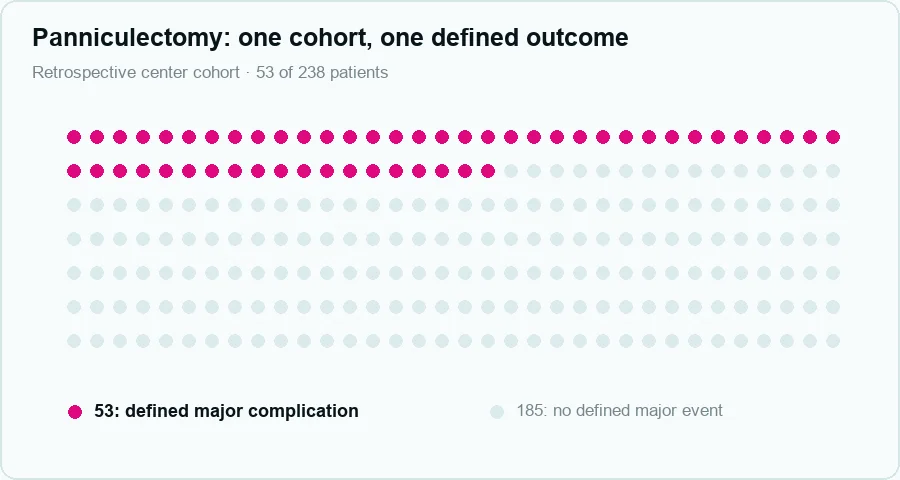
In the 238-patient study, 53 patients had a major complication, reported as 22.3%. Its definition included infection and specified fluid collections, bleeding collections or open wounds requiring intervention. Mean follow-up was 50 months, with substantial variation. This is a retrospective center-specific result, not a national risk estimate. Minor complications were recorded separately, so the major category does not represent every possible postoperative problem. Study definitions and results
A different original registry study analyzed 11,137 patients from 2015–2019: 6,397 functional panniculectomy and 4,740 cosmetic abdominoplasty cases. The functional group had more underlying health conditions and higher observed adverse-event measures. The comparison does not show that changing the label of an operation makes an otherwise identical patient safer. Selection and health differences matter. Original multicenter comparison
| Evidence | What was measured | What it cannot establish |
|---|---|---|
| 238-patient center cohort | Defined major complications, mean follow-up 50 months | Your personal probability or a universal eligibility cutoff |
| 11,137-patient registry comparison | Different functional and cosmetic populations | Causal superiority of one procedure for the same person |
| Your clinical assessment | Health, actual tissue problem and proposed scope | A guarantee that complications will not occur |
A study percentage belongs to its defined outcome and study population. Ask your team which complications are relevant to your proposed operation, how they would be recognized and who would manage them. An answer that supplies an escalation plan is more useful than one that promises an uncomplicated course. Do not add major and minor study percentages together without knowing whether categories overlap.
A simple cohort diagram can help retain the denominator: the original center report identified major complications in 53 of 238 patients. Highlighting those patients within the whole study sample explains the reported fraction; it does not describe 238 future patients at another practice. A second study with a different follow-up period or outcome definition should receive its own display. Putting two percentages on adjacent bars can imply a fair treatment comparison even when no such comparison was performed.
Panniculectomy recovery needs an individual care plan
ASPS describes dressings, possible compression support and temporary drains, with individual instructions for wound care, medicines, concerning symptoms and follow-up. Healing continues over several weeks. The society specifically encourages questions about showering, activity, exercise and drain duration; it does not offer one schedule that fits every operation. ASPS recovery guidance
Build your practical plan around tasks rather than a single deadline. A desk job, a job involving lifting and responsibility for a dependent create different problems to solve. Describe those tasks before requesting leave. Ask who will help with meals, transport, household responsibilities and any care you cannot comfortably perform. Avoid promising an employer a return date before the surgical team has assessed the actual work demands.
Confirm the contact route during office hours and after hours. Ask what observations require a call, an urgent assessment or emergency care. Get instructions in an accessible format, including who can help if you have difficulty seeing or reaching the incision. Do not improvise drain removal, dressings or compression from another person’s account; the relevant details depend on your operation and healing.
Agree on how functional progress will be recorded at follow-up. Return to the tasks named before surgery rather than judging success solely by a photograph. Record whether the original fold-related concern is improved, unchanged or still being evaluated, and note any new care burden. A clinician can then interpret the changes alongside wound findings. This record does not replace an examination or force recovery into a fixed timetable; it preserves the reason you sought treatment and makes unresolved concerns easier to discuss.
ASPS advises immediate medical attention for shortness of breath, chest pain or unusual heartbeats after returning home. Its results guidance also explains that swelling can obscure the early contour and that scars change over time. An early photograph is therefore a time-specific record rather than a final result. ASPS results and urgent symptoms
Panniculectomy coverage is a separate, policy-specific determination
Some panniculectomy operations may be covered, but ASPS advises checking with the insurer before surgery. Costs can include surgeon, facility and anesthesia fees, medicines, garments and tests. There is no justified universal total price on that page, and a covered clinical indication does not tell you your complete out-of-pocket obligation. ASPS cost guidance
One concrete example is Medicare local coverage determination L39506 for CGS jurisdiction J15 in Kentucky and Ohio, revised effective May 21, 2026. It specifies documented indications and limitations for panniculectomy, including skin-fold problems and conservative-treatment evidence. It distinguishes covered treatment from solely cosmetic work. This local policy is not a national promise of Medicare or private-insurance payment. Confirm the current applicable policy and complete documentation with your own plan. CMS local policy L39506
A coverage checklist should identify the plan, policy identifier, effective date, proposed procedure, required clinical records and decision status. Keep a written authorization or coverage response alongside its conditions. If a proposed package contains additional contouring, ask for those costs to be separated before you sign. An estimate should also explain deductibles or other patient obligations and what happens if the final billed services differ.
| Financial item | What to obtain | Avoid assuming |
|---|---|---|
| Functional removal | Exact proposed service and documentation | Every skin apron qualifies |
| Additional contouring | Separate elective scope and quote | Approval of removal covers all additions |
| Facility and anesthesia | Written inclusion and billing arrangements | A surgeon fee is the total |
| Follow-up and complications | Coverage and charging policies | Every later service is prepaid |
| Plan decision | Applicable policy and written response | Another patient’s approval predicts yours |
For an appeal or additional documentation request, ask which requirement remains unmet and who can provide accurate supporting records. Never embellish symptoms or photograph findings to fit a policy. If payment remains uncertain, establish the financial alternatives before surgery rather than treating an initial conversation as final approval.
Decide using a complete, bounded plan
A useful panniculectomy decision ends with four clear records: the clinical problem, the proposed removal and any additions, the recovery and complication support plan, and the financial or coverage arrangements. If one is unclear, identify the missing information. Another opinion is most informative when it addresses that specific gap instead of simply offering a different package price.
You can defer treatment, continue assessment or decline an added procedure. Separate functional goals from appearance preferences, and retain realistic uncertainty about healing and final contour. The objective is an operation whose purpose and responsibilities you understand, not a promise that one intervention resolves every abdominal concern.
Before booking, check that the consent description and financial documents name the same proposed services. If the plan changes after another examination, ask for updated records. A previously discussed quote or coverage response should not silently become the basis for a different operation.
For related planning, see our tummy tuck guide, cost planning guide and recovery planning guide.
Sources and review scope
Plastic Surgery Editorial Team. Sources checked October 11, 2026. Review scope: source and editorial checks for general education. No individual clinical assessment is represented.
- ASPS scope and limitations. plasticsurgery.org. Publication/update date not stated. Checked 2026-10-11.
- ASPS candidacy. plasticsurgery.org. Publication/update date not stated. Checked 2026-10-11.
- ASPS consultation. plasticsurgery.org. Publication/update date not stated. Checked 2026-10-11.
- ASPS preparation. plasticsurgery.org. Publication/update date not stated. Checked 2026-10-11.
- ASPS incision description. plasticsurgery.org. Publication/update date not stated. Checked 2026-10-11.
- ASPS risks. plasticsurgery.org. Publication/update date not stated. Checked 2026-10-11.
- ASPS recovery. plasticsurgery.org. Publication/update date not stated. Checked 2026-10-11.
- ASPS results. plasticsurgery.org. Publication/update date not stated. Checked 2026-10-11.
- ASPS cost. plasticsurgery.org. Publication/update date not stated. Checked 2026-10-11.
- Original 238-patient retrospective center cohort. pmc.ncbi.nlm.nih.gov. Source date: 2021-11-24. Checked 2026-10-11.
- Original functional versus cosmetic registry analysis. pubmed.ncbi.nlm.nih.gov. Source date: 2022-04-28. Checked 2026-10-11.
- CMS LCD L39506. cms.gov. Source date: 2026-05-21. Checked 2026-10-11.