
Liposuction removes localized fat through small surgical incisions to change body contour. It does not replace weight management, remove a substantial skin fold, or reliably correct cellulite. The useful starting question is therefore not how many pounds a procedure removes: it is which visible concern comes from removable fat, which comes from skin, and what result remains uncertain after examination. ASPS overview
A complete proposal should identify the regions treated, the reason for the technique, the anesthesia and facility plan, the recovery arrangements, and the full quoted scope. Compare those items before comparing prices or device names. The goal map and evidence worksheet below help turn a broad request such as “reshape my waist” into a proposal you can understand, including the option of postponing treatment or choosing no procedure.
Start with the concern, not the treatment label
Write your priority in everyday language: a bulge at the outer thigh, a difference between the waist and hips, or the way a particular garment fits. Describe the situation in which you notice it, rather than assigning yourself an anatomical diagnosis. A contour concern can be real without your preferred explanation being correct. The examination should connect that concern to a proposed change, not simply confirm that the requested procedure is available.
The American Society of Plastic Surgeons identifies localized fat deposits in several body regions as potential treatment targets. It also emphasizes skin elasticity and the limits of fat removal when skin is loose. That distinction matters because a smaller underlying volume does not itself tell you what the remaining skin will look like. A promise to “tighten everything” needs a separate explanation of what is being treated and by which method. ASPS treatment scope
Use this original planning table to record the examination and proposed endpoint. It is a discussion aid, not a home test for candidacy. Leave the clinical explanation blank until a qualified clinician supplies it. If different consultations produce different explanations, preserve both rather than blending them into a reassuring but unsupported conclusion.
| What you notice | Examination question | Proposal should specify | Unresolved endpoint |
|---|---|---|---|
| Localized contour bulge | Is removable fat the main target? | Exact region and intended contour change | Amount of change and remaining asymmetry |
| Loose skin or a hanging fold | What role does the skin envelope play? | Whether skin removal is being proposed separately | Scar tradeoff and residual looseness |
| Dimpling or surface irregularity | Is this concern within this treatment’s scope? | What the operation will and will not address | Surface appearance after healing |
| Broad abdominal fullness | What explains the contour on examination? | Boundaries of the proposed fat-removal operation | Concerns requiring a different assessment |
Avoid turning the map into a wish list of additional surgery. Its purpose is to identify a mismatch early. If your highest priority is outside the operation’s intended scope, adding more treated regions does not fix that mismatch. A clear explanation of a limitation can be more useful than a larger package. Ask which concern the clinician expects to remain visible and whether that would still make the proposed result worthwhile to you.
What the operation involves, and what a technique name leaves out
The basic operation uses a hollow instrument called a cannula to remove fat through incisions. ASPS describes anesthesia options, fluid infiltration, and several assisted techniques. These are components of an operation rather than interchangeable descriptions of its complete scope. An anesthesia choice, a fluid technique, and an energy-assisted device can appear in the same proposal. Ask the clinician to explain the actual combination instead of comparing isolated names. ASPS procedure explanation
For example, a quote that advertises an assisted technique may still leave the treated boundaries unclear. Another quote may use a more familiar name but describe the regions and follow-up more precisely. Neither presentation proves a better outcome. Ask what patient-relevant problem the proposed method is intended to solve, what evidence supports that purpose, and whether the evidence concerns your region and situation. Distinguish an operator’s workflow benefit from an improvement you would notice.
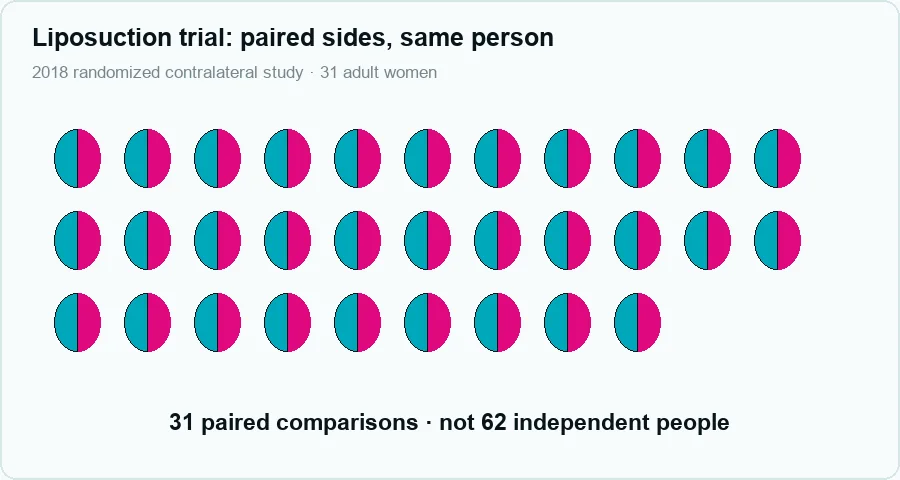
An original randomized, contralateral study published in 2018 compared tissue liquefaction with suction-assisted liposuction in 31 adult women. Each participant contributed a comparison within the same body. The investigators measured extraction efficiency and recovery-related ratings, rather than establishing a universal winner for every body region or patient. Its abstract reports faster extraction with the studied device. That is a specific result from a particular comparison, not proof that every newer technique produces a superior final contour. Original comparative trial, published August 16, 2018
The distinction between study endpoints is useful even when you do not want to read a technical paper. “Less time to extract fat,” “less early bruising,” “better contour at a defined follow-up,” and “greater patient satisfaction” answer different questions. A favorable result for one should not silently become a claim about all the others. Ask to see the endpoint that matches the benefit being advertised, alongside the comparison group and observation period.
| Technique claim | Evidence question | What would make it useful | What it cannot establish alone |
|---|---|---|---|
| Faster treatment | Faster at which measured step? | Comparable operation scope and measured time | Better final appearance |
| Easier recovery | Which symptoms, measured when? | Clear assessment method and comparator | A guaranteed return-to-work date |
| Better contour | Who assessed it, and at what follow-up? | Consistent photographs or defined outcome measure | Your individual result |
| More skin tightening | How was change measured? | Relevant skin characteristics and follow-up | Removal of a substantial excess-skin fold |
Record the exact device or technique offered, but do not let that field dominate the decision. Add the proposed regions, clinical rationale, expected limitation, and available comparison evidence beside it. If the explanation is simply “the latest technology,” request a more specific answer. A technology can be authorized or commonly used without every marketing statement about it having been demonstrated.
Liposuction and nonsurgical contouring are different choices
Noninvasive contouring treatments work without surgical fat extraction through incisions. FDA guidance distinguishes them from liposuction and describes technologies using cold, heat, ultrasound, and other mechanisms. Effects depend on the specific device and intended use; some may be temporary or require repeated treatment. These treatments also carry risks. An offer described as nonsurgical therefore needs its own device identity, intended body site, expected endpoint, and follow-up plan. FDA noninvasive contouring guidance
The fair comparison is between complete treatment plans. One session of a nonsurgical procedure and a surgical quote for multiple regions are not equivalent purchases simply because both use the word “contouring.” Put the number of proposed visits, region boundaries, assessment date, included follow-up, and possibility of further treatment on the same sheet. Do not assume that a quoted session price buys the desired endpoint.
Similarly, a device’s marketing authorization is not a prediction about your outcome. Ask which intended use and body site apply to the actual device being offered. If the provider describes a different purpose, ask for the basis of that use and its uncertainty. Keep surgical extraction, noninvasive treatment, and injectable products in separate rows; sharing a cosmetic goal does not make their evidence or risks interchangeable.
Candidacy is an assessment, not a size chart
ASPS describes good general health, realistic contour goals, suitable skin characteristics, and nonsmoking or nonvaping status among candidacy considerations. These are reasons for an individualized assessment, not an online approval checklist. Being able to identify a localized bulge does not answer questions about healing, anesthesia, or the appropriateness of the full procedure. Tell the clinician about health conditions and previous treatment even if they seem unrelated to the contour concern. ASPS candidacy guidance
Bring a current medication and supplement list, previous operative history, allergies, and an honest account of tobacco, vaping, alcohol, and other substance use. ASPS includes these subjects in its consultation guidance. The point is not to pass a consultation by giving the expected answers. It is to let the team identify relevant risks and decide whether the proposal needs to change. A different facility, reduced scope, or a decision against treatment may be the appropriate outcome. ASPS consultation scope
Photographs and measurements can help document the starting point, but a visual record should serve a defined question. Ask what the team is assessing and how it will compare the eventual result. Record your priorities separately from the clinician’s observations. “I want a smoother clothing silhouette” is a goal; “this technique can achieve that without addressing skin” is a clinical proposition that needs explanation. Keeping the two separate makes informed disagreement possible.
Understand risks in the context of the planned operation
ASPS lists risks including infection, fluid accumulation, persistent sensation changes, contour irregularity, poor healing, injury to deeper structures, and serious clot-related or cardiopulmonary complications. It also identifies heat injury as a concern with ultrasound-assisted treatment. A list establishes that these events belong in consent; it does not provide your probability of experiencing one. Ask which risks are most relevant to your health, regions, and combined procedure plan. ASPS risks and safety
Separate appearance problems from problems needing urgent care. Ask the team for written instructions explaining symptoms that require immediate attention, whom to contact after hours, and where to go if the operating team cannot assess you. Keep those instructions accessible to your support person. A cosmetic procedure should not leave you improvising an emergency communication plan while uncomfortable or away from home.
Do not treat an advertised volume as a personal safety target or proof of value. Ask how the team defines the reported amount and why the planned scope is appropriate. A figure can refer to a different measured material or stage of the procedure than a reader assumes. The useful consent question is what the team plans to do and how that plan changes monitoring and follow-up, not whether a larger number sounds more impressive.
| Safety planning item | Written answer to request | Why a vague answer is insufficient |
|---|---|---|
| Treated regions and combined operations | Actual planned scope | A package name does not describe the operation |
| Anesthesia and location | Responsible team and exact facility | “In office” does not identify the care arrangements |
| Unexpected problem | Contact, assessment and transfer pathway | Availability should be defined before treatment |
| Follow-up away from home | Who will examine you and when | A message exchange is not the same as examination |
Verify credentials and facility arrangements rather than relying on an attractive gallery. ASPS recommends asking about board certification, procedure training, hospital privileges, and the facility’s accreditation or licensing. These questions concern different parts of care. An individual credential does not automatically answer the facility question, and a facility credential does not establish a particular operator’s experience with your proposed scope. ASPS credential and facility questions
Compare total quotes without inventing a national price
The surgeon’s fee is only one component of a liposuction bill. ASPS specifically distinguishes it from anesthesia, operating facilities, and related expenses. A national fee headline is therefore not a reliable estimate of what you will pay for a specific set of regions. Request a dated, itemized quote showing what is included, what can vary, and which additional services you would pay for separately. ASPS fee-scope explanation
Our comparison worksheet deliberately has no invented dollar examples. Enter amounts from actual written proposals. First label each region on a simple diagram and use the same labels in both quotes. If one practice counts the abdomen and waist differently, request a description of the boundaries. A price difference cannot be interpreted until you know whether the two proposals describe the same treatment.
Then separate included follow-up from optional or contingent items. Ask about garments, prescribed medication, tests, anesthesia charges, facility charges, and policies for additional treatment. Do not add a hypothetical revision cost to every quote as though another operation were certain. Instead, record the policy and the circumstance in which a new charge would arise. Keep travel and time away from work in a personal planning column.
| Quote field | Proposal A | Proposal B | Comparison action |
|---|---|---|---|
| Region boundaries | Enter written scope | Enter written scope | Resolve any mismatch first |
| Surgeon, anesthesia and facility | Enter included amounts | Enter included amounts | Mark variable charges |
| Tests, garments and medication | Enter inclusion status | Enter inclusion status | Add only known separate charges |
| Follow-up and additional treatment policy | Enter actual terms | Enter actual terms | Distinguish routine from contingent care |
For a reproducible comparison, sum only confirmed amounts, label unknown charges as unknown, and preserve the date of each proposal. Do not replace missing items with estimates from an unrelated website. A lower confirmed subtotal with several unresolved charges may be less informative than a higher complete quote. The worksheet is successful when it identifies the next question, even if it cannot yet produce a defensible total.
Plan recovery around actual responsibilities
Recovery instructions may address dressings, compression garments, medications, incision care, activity, and follow-up. Some people have drainage tubes and receive instructions for recording drainage. ASPS presents a general recovery timeline, but the relevant plan is the one issued for your actual operation. Return to a desk, return to strenuous work, and return to exercise are separate decisions. Do not compress them into one advertised downtime number. ASPS recovery guidance
Describe your job in tasks rather than its title. Tell the team whether it involves prolonged standing, lifting, bending, driving, uniforms, or limited access to breaks. Include unpaid responsibilities: childcare, helping another adult, shopping, pet care, and travel to appointments. Ask what restrictions apply to each task and what change in the recovery plan would warrant reassessment. Arrange a fallback if your first expected work date proves unrealistic.
Preparation also includes transport and practical support. ASPS recommends arranging someone to drive you to and from surgery and stay for at least the first night. Its preparation guidance discusses evaluation, medications, and smoking or vaping. Have medication changes coordinated with the prescribing clinician and operating team; do not discontinue a prescription because a general web page lists a category of concern. ASPS preparation guidance
Build the home plan around the written instructions. Decide who can help you dress, get meals, attend visits, and locate the emergency contact information. Ask how the team wants questions and photographs sent, and when a concern requires examination instead of remote reassurance. Practical preparation is not proof that a procedure is appropriate, but it prevents an otherwise detailed surgical discussion from overlooking the setting in which recovery happens.
Evaluate the result with a defined question and date
Swelling can take months to settle, and contour assessment should account for the stage of healing. ASPS notes that results are not guaranteed, aging continues, and another operation may sometimes be needed. Ask when your team intends to assess the specific endpoint discussed before surgery. An early photograph and a later result can answer different questions; neither should be presented without its timing. ASPS results and limitations
For your own record, keep the original goal statement, the agreed treatment boundaries, and the clinician’s stated limitation. At follow-up, discuss whether that same goal has changed, whether healing still limits assessment, and what concern needs examination. Avoid judging success by an unrelated patient’s photograph or by the amount reportedly removed. The meaningful comparison is between your documented starting concern and the outcome the team actually proposed.
If a gallery influences your decision, ask whether photographs show the same operation, additional procedures, and a comparable follow-up interval. Look for consistent views and clearly stated circumstances. A striking example illustrates possibility; it does not establish how often that result occurs. Likewise, a dissatisfied account deserves attention without becoming a personal prediction. Evidence quality and the fit of the treatment plan matter more than the emotional force of a single image.
The strongest decision record fits on a few pages: your priority, the examination’s explanation, the proposed scope, the evidence behind any technique claim, the complete quote, and the recovery and follow-up responsibilities. If one of those remains unclear, resolve it before committing. Liposuction is easier to assess when the expected contour change and its limits are explicit, rather than hidden inside a procedure name or a promotional package.
For related procedure planning, see the tummy tuck guide and the procedure library.
Sources and review scope
Plastic Surgery Editorial Team. Source records checked through October 11, 2026. Review scope: source and editorial checks for general education. No individual clinical assessment is represented.
- ASPS liposuction Overview. plasticsurgery.org. Publication/update date not stated. Checked 2026-10-11.
- ASPS liposuction Procedure. plasticsurgery.org. Publication/update date not stated. Checked 2026-10-11.
- ASPS liposuction Safety. plasticsurgery.org. Publication/update date not stated. Checked 2026-10-11.
- ASPS liposuction Cost. plasticsurgery.org. Publication/update date not stated. Checked 2026-10-11.
- ASPS liposuction Recovery. plasticsurgery.org. Publication/update date not stated. Checked 2026-10-11.
- ASPS liposuction Preparation. plasticsurgery.org. Publication/update date not stated. Checked 2026-10-11.
- ASPS liposuction Candidates. plasticsurgery.org. Publication/update date not stated. Checked 2026-10-11.
- ASPS liposuction Results. plasticsurgery.org. Publication/update date not stated. Checked 2026-10-11.
- ASPS liposuction Consultation. plasticsurgery.org. Publication/update date not stated. Checked 2026-10-11.
- ASPS liposuction Questions. plasticsurgery.org. Publication/update date not stated. Checked 2026-10-11.
- Hunstad et al. randomized contralateral comparison. pubmed.ncbi.nlm.nih.gov. Source date: 2018-08-16. Checked 2026-10-11.
- FDA noninvasive body contouring. fda.gov. Publication/update date not stated. Checked 2026-10-11.