
Botulinum toxin eyelid droop can occur after treatment, but a lowered eyelid should be assessed rather than diagnosed from a photograph or automatically blamed on the injection. The BOTOX Cosmetic label describes eyelid ptosis in specific clinical-trial regimens and separately describes brow ptosis. Those are different findings. Contact the treating clinician about a new change, provide the actual treatment record and ask what assessment is appropriate. Trouble breathing, speaking or swallowing after toxin treatment requires immediate medical attention under the label’s spread-of-effect warning.
This answer addresses the clinical conversation after a concern, not injection placement or a home correction. It supplies no eye-drop prescription, dose, massage instruction or promise that every droop resolves on a particular date. Product identity matters: toxin preparations have their own labeling, and their units cannot be converted through a generic internet formula. The clinician must assess what has changed and whether another explanation or a different level of care needs consideration.
What does botulinum toxin eyelid droop mean?
Eyelid ptosis refers to a lowered eyelid. A lowered brow is a different observation, even though either can change how the upper eye area looks. A reader may describe heaviness, an uneven fold or a lid that appears lower without knowing which structure is responsible. Report the observation in your own words instead of selecting a diagnosis that fits a search result. A photograph can document appearance but cannot complete an examination or determine why the change happened.
For a botulinum toxin eyelid droop assessment, useful detail includes which side changed, when you first noticed it and whether your vision or ability to use the eye has changed. State what you know and what you do not know. An old photograph may show that asymmetry existed previously, but it does not establish that a new symptom is harmless. Conversely, a change noticed after an appointment does not by itself prove the injection caused it. Both the clinical history and current findings matter.
What does the actual BOTOX Cosmetic label report?
The opened label, updated October 18, 2024 and revised October 2024, reports eyelid ptosis in specified glabellar-line trial regimens and brow ptosis in a different forehead-line context. These endpoints should not be combined into one universal droop percentage. Study populations, treated regions and regimens define the meaning of a reported event. A trial frequency is not a prediction for your individual treatment, and a different toxin brand cannot inherit the same number without its own evidence. Read the actual BOTOX Cosmetic prescribing information.
The label supports taking botulinum toxin eyelid droop seriously as a possible adverse effect; it does not diagnose your concern. Keep the label’s product name and treatment context attached to any discussion of its evidence. A clinic’s summary of a common side effect is useful only if the responsible clinician also explains the actual assessment and follow-up arrangement. This page has not inspected your treatment record, verified the product used or evaluated the practitioner who performed the procedure.
Which symptoms need immediate medical attention?
The toxin label warns about effects involving breathing, swallowing or speaking and directs immediate medical attention for those difficulties. Do not wait for an aesthetic follow-up or a photograph review when those symptoms occur. A complaint about the eyelid should not obscure another symptom simply because the appointment was cosmetic. Tell the clinician or emergency team about the toxin exposure and the product if known, but do not delay seeking care while trying to obtain a batch number.
A botulinum toxin eyelid droop search is also an unsuitable way to assess a sudden visual or neurological change. Tell the care team exactly what you are experiencing and ask for the appropriate response. This guide does not provide a checklist that rules out an eye or neurological emergency, and it does not declare every isolated droop nonurgent. If the initial contact cannot assess the problem, ask where and how you should obtain medical evaluation rather than interpreting silence as reassurance.
What record should you request from the treating practice?
Request the actual preparation name, treatment date, treated areas and the clinical record relevant to the concern. The practice should identify the documented treatment rather than relying on the generic word Botox for every toxin. Keep your own description of when the appearance changed, any accompanying symptoms and contact attempts. If a detail is missing, mark it unknown. Guessing the brand, amount or location can make a later conversation less accurate.
For botulinum toxin eyelid droop, a record request should support care rather than postpone it. Ask who can supply the information and who is responsible for assessing you. Those may be different people. A receptionist’s ability to send a receipt is not the same as a clinician making a management decision. If you seek another opinion, share the actual record and previous assessment so that the next clinician can distinguish confirmed findings from an untested explanation or an internet diagnosis.
How should you describe the change without diagnosing it?
Use plain observations: the upper lid looks lower on one side, the brow position appears different, the change was noticed on a certain day or a particular activity has become harder. Separate what is visible from what you feel. Avoid a label such as nerve injury unless that diagnosis has actually been made. Ask the clinician to document their finding, the uncertainty remaining and what should trigger a different response. The description can become more precise after an examination.
A botulinum toxin eyelid droop concern can produce repeated checking and conflicting photographs. If the care team requests images, follow its instructions and identify the date without filters or an edited expression. Images from different angles or facial efforts should not be treated as a controlled measurement. Your task is to communicate the change clearly; the clinician’s task is to interpret it with the history and examination. A more dramatic online image does not determine the severity or cause of your own concern.
What should an assessment conversation cover?
Ask what the clinician found, whether the finding involves the eyelid, brow or another structure, and how confident they are about its explanation. Ask whether additional examination or referral is needed and who will arrange it. If observation is proposed, request the reason, the follow-up plan and the symptoms that should prompt earlier contact. Observation is an actual clinical decision; an article cannot substitute a generic wait-and-see period for it.
When botulinum toxin eyelid droop is discussed, distinguish the explanation from the plan. A clinician may consider the treatment history relevant while still needing to assess another possibility. The plan should explain what is being monitored and what would change the decision. Ask for written instructions in language you understand. Do not convert a statement that a side effect can be temporary into a guarantee about your diagnosis, recovery date or ability to ignore worsening symptoms.
Why does this page avoid a universal recovery countdown?
A countdown borrowed from a general cosmetic-effect duration article does not tell you when an eyelid concern will resolve. The exact finding, cause and clinical assessment must be considered. The label’s reported adverse effects and the usual persistence of an intended wrinkle effect are different endpoints. This answer therefore does not use a promised number of days or months as permission to postpone assessment. It also does not interpret an unchanged appearance on one day as treatment failure.
For botulinum toxin eyelid droop planning, ask what follow-up interval the clinician recommends for your assessed problem and why. Record it as that clinician’s plan, not a universal rule for everyone reading the page. If the concern changes, describe the change instead of waiting merely because an earlier appointment remains on the calendar. Ask how you will reach the responsible team outside routine hours and how referrals or further assessments will be communicated.
Can an online remedy or borrowed eye drop help?
This guide does not recommend a medicine, borrowed prescription, injection or mechanical maneuver to correct the appearance. Whether a proposed intervention is appropriate depends on the actual diagnosis and your medical circumstances. Ask a qualified clinician what the proposal aims to achieve, its limits and risks, and whether it addresses the cause or only a symptom. A story of improvement online cannot establish that the same intervention is suitable for you.
A botulinum toxin eyelid droop discussion should keep correction advice within actual clinical care. If someone recommends an intervention without reviewing the product record or assessing the eye, ask who is making the decision and on what basis. Do not buy a product because it is described as an antidote. A general aftercare instruction from the original appointment should also not be repurposed as a treatment for a newly developed concern without asking the responsible clinician. The blepharoplasty guide explains that procedure and its consultation questions separately.
How can the decision questions be organized?
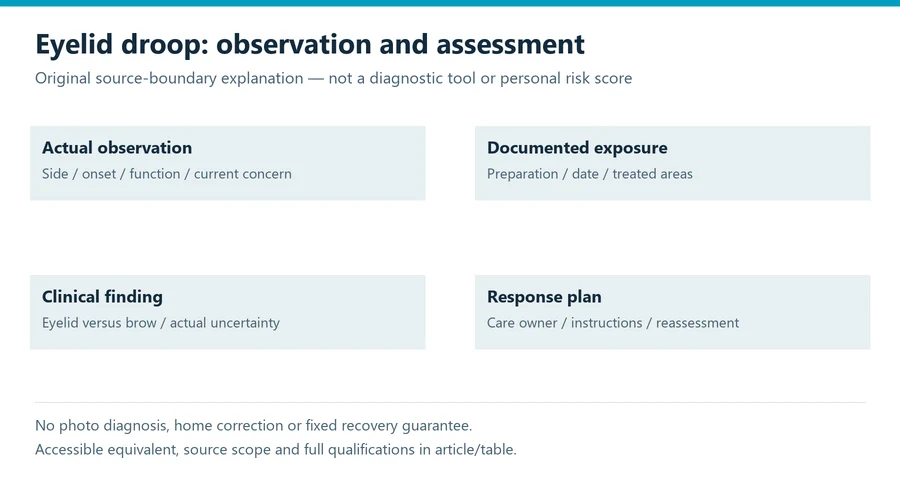
| Question | Useful information | Boundary |
|---|---|---|
| What changed? | Actual observation, side and onset | Not a diagnosis from a photograph |
| What treatment occurred? | Documented preparation, date and areas | No generic unit conversion |
| What did assessment find? | Clinician finding and remaining uncertainty | Lid and brow findings differ |
| What happens next? | Care owner, follow-up and escalation instructions | No universal recovery countdown |
Keep the finding and plan distinct
The organizer is original planning guidance. It does not grade severity or choose a treatment. Use it to make the botulinum toxin eyelid droop conversation specific enough that you know what has been established and what remains open. If the record is incomplete, the unknown should remain visible. If the clinician recommends a referral, ask who initiates it and how its result will reach the team managing the concern. Administrative clarity helps you follow an actual plan but does not prove that the proposed plan is clinically correct.
What if the appointment was described as routine or low risk?
ASPS education lists facial weakness or drooping among possible toxin effects and discusses spread symptoms. That general information is not a product-specific risk estimate or a personal assurance. A routine cosmetic appointment still requires a route to clinical assessment when a concern arises. Request the actual informed discussion and aftercare information rather than assuming a familiar service name means that every complication can be handled through ordinary customer support. Read ASPS botulinum toxin safety education.
Botulinum toxin eyelid droop questions can be asked without deciding that the clinician made an error. The relevant immediate task is an accurate assessment and appropriate care. A separate discussion about expectations, records or dissatisfaction should not replace that task. This page makes no judgment about a named practitioner, technique or cause, and it provides no provider ranking. A person’s confidence on social media is not evidence that they have examined your concern or reviewed the actual preparation used.
What should be recorded after the assessment?
Keep the assessment date, the clinician’s finding, the recommended next step and the contact route for change. If medication or another intervention is prescribed, retain the actual instructions from the responsible professional rather than substituting a summary from this page. If further assessment is pending, record the appointment and how new concerns will be handled in the meantime. Label a tentative explanation as tentative until the clinician tells you it has been established. For separating reported Botox duration from a personal retreatment forecast, see how long does botox last.
For botulinum toxin eyelid droop, a useful follow-up record separates appearance, function and instructions. A change in one does not necessarily answer the others. Write down questions you still have, especially if different clinicians used different terms. Ask them to clarify whether they are describing the same finding or considering separate explanations. The record should help the next appointment begin with shared facts rather than forcing you to reconstruct the entire sequence from memory.
How should a second opinion be prepared?
A second opinion is most useful when it receives the actual treatment details, prior assessment and your reason for seeking further evaluation. Explain whether your concern is uncertainty about the diagnosis, a worsening symptom, the proposed intervention or an unclear follow-up arrangement. Do not conceal an earlier treatment or remove part of the record to obtain a preferred answer. Ask the second clinician which questions they can answer and whether another specialist or examination is needed.
The botulinum toxin eyelid droop record can remain concise while being complete: documented exposure, observed change, accompanying symptoms, assessments and actual instructions. It does not need an online theory about every possible mechanism. If records have not arrived, share what is known and identify the missing details honestly. Immediate care should not be delayed to create a polished file. The article’s practical contribution is a clearer conversation, not a remote diagnosis or a predicted result.
How should a concern that affects daily tasks be communicated?
Tell the assessing clinician if the change affects a practical task such as reading, working or driving, and ask for advice appropriate to the actual finding. This article does not decide that you can safely perform those activities or assign a restriction from a photograph. A description of function is useful alongside appearance because the clinician needs to understand what the concern means in daily life. Avoid minimizing it merely because the original appointment sought a cosmetic benefit.
For botulinum toxin eyelid droop, distinguish your observed difficulty from a conclusion about its cause. State what happens, when it happens and whether it has changed. If the clinician recommends a task restriction or adaptation, request the actual instructions and how they will be reassessed. An appearance-based recovery countdown does not answer a functional safety question. Record the advice with its date, particularly if another clinician later evaluates the concern or gives a different instruction.
What can you ask when the explanation is unclear?
Request a plain-language distinction between what was observed, what is suspected and what has been established. Ask whether the clinician’s use of ptosis refers to the lid or brow and whether they are describing a finding or assigning its cause. A term can sound definitive while still leaving an important question open. Repeat the actual instruction in your own words and ask whether you have understood it correctly; that is a communication check, not an independent assessment.
A botulinum toxin eyelid droop discussion should leave you knowing the next action and whom to contact. If the answer is simply that the problem is common, ask how your specific concern has been assessed and what happens if it changes. A general statement may supply context, but it cannot substitute for the finding, plan and response route. Keep unresolved questions visible rather than assuming they were answered because the appointment ended.
What does the pooled registration evidence distinguish?
An original analysis published September 9, 2023 pooled eighteen registration studies of onabotulinumtoxinA for upper facial lines. Its findings help explain why botulinum toxin eyelid droop should not be merged automatically with brow ptosis: the study recorded them as separate adverse-event categories, and both were statistically higher in the double-blind treated group than placebo. That distinction concerns measured study endpoints; it does not diagnose the reason for your current appearance.
The overall pool included 5,298 participants, but the reported double-blind comparison comprised 3,431 treated participants and 1,359 receiving placebo. The larger headline total should not become the denominator for every comparison. The analysis was retrospective and ad hoc, included specific facial regions and a specific product, and disclosed manufacturer-associated authors and other conflicts. These limits matter before turning a pooled result into an individual forecast. Ask which finding the clinician actually identifies and which evidence applies to that finding; this study supplies neither a home correction nor a recovery countdown.
Read the original source and its stated scope.
What should change a future treatment discussion?
Tell any future treating clinician about the actual concern, assessment and outcome before considering another toxin appointment. A different preparation, area or proposed regimen needs its own discussion; none should be selected through a unit-conversion shortcut or an assumption that another product automatically prevents recurrence. Ask how the previous finding affects the clinical proposal and whether uncertainty needs resolution before another elective intervention is considered.
Botulinum toxin eyelid droop should remain an assessed medical concern rather than a label permanently assigned from a search. Future choices should use the actual diagnosis and record, including any remaining uncertainty. Keep intended cosmetic benefit, complication assessment and scheduling as separate questions. For broader treatment selection, use the procedure guide alongside the responsible clinician’s advice. This answer helps organize product and assessment questions; it supplies no personal clearance, correction prescription or guaranteed recovery date.
Sources and review scope
Plastic Surgery Editorial Team. Source records checked through October 12, 2026. Review scope: source and editorial checks for general education. No individual clinical assessment is represented.
- BOTOX Cosmetic opened prescribing information. dailymed.nlm.nih.gov. Source date: 2024-10-18. Checked 2026-10-12.
- ASPS botulinum toxin safety. plasticsurgery.org. Publication/update date not stated. Checked 2026-10-12.
- Original pooled onabotulinumtoxinA registration-study safety analysis. pubmed.ncbi.nlm.nih.gov. Source date: 2023-09-09. Checked 2026-10-12.