
Sleep apnea and outpatient surgery require an individual anesthesia and setting assessment. Tell the surgical and anesthesia teams about diagnosed or suspected apnea, prescribed treatment and relevant symptoms before scheduling. The procedure, other medical conditions, pain medicines, facility capability and observation after discharge all matter. A diagnosis does not automatically mean every procedure must occur in a hospital, and a same-day booking does not establish that going home is appropriate. This resource supplies no personal clearance, screening-score diagnosis or CPAP prescription.
Why do sleep apnea and outpatient surgery need planning?
The ASA patient page explains that obstructive sleep apnea can complicate anesthesia and recovery because breathing and response to anesthesia may be affected. NHLBI also advises telling clinicians about apnea when anesthesia or postoperative pain medicines are planned. Those sources support disclosure and individualized precautions, not a conclusion that a particular person is safe or unsafe for every operation. The actual intervention and care arrangement must be assessed.
Begin by separating the sleep condition from the cosmetic or reconstructive goal. A successful treatment plan for apnea is relevant information, but it does not independently choose the anesthesia or facility for another procedure. Likewise, a brief procedure name does not establish the complete perioperative plan. Ask how the clinical team will assess the actual history and what additional information is useful. This page’s original organizer helps you prepare that conversation; it is not a validated risk score or a way to diagnose apnea from a partner’s report, a wearable device or a few questionnaire answers.
Read the ASA sleep-apnea and anesthesia guidance.
What should you disclose before scheduling?
Tell the team about an established diagnosis, relevant sleep-study information, prescribed treatment and any difficulty using that treatment. If you suspect apnea but have not been assessed, describe the concern honestly rather than label yourself diagnosed or dismiss it because a formal test is missing. The ASA patient page encourages discussing known or suspected obstructive apnea with the care team. The clinician decides what further assessment is appropriate.
For sleep apnea and outpatient surgery, an accurate history is more useful than a claim that you qualify because symptoms seem mild. Record the actual diagnosis and treatment separately from observations such as reported snoring or interrupted breathing. Bring the documents the team requests and ask how to obtain missing records. This article does not prescribe a sleep study, diagnose severity or establish that a device reading rules out apnea. It also does not advise concealing symptoms to preserve a surgery date. The point of early disclosure is to let the relevant clinicians assess the proposal before practical commitments make an unresolved clinical question harder to address.
Does the condition always require inpatient surgery?
The ASA’s February 2014 perioperative guideline describes an individual decision about inpatient versus outpatient care. It identifies multiple considerations, including apnea status, other disease, procedure and anesthesia, postoperative opioid needs, observation after discharge and facility capability. It also acknowledges insufficient literature for a universal rule about which patients can safely be managed in each setting. The guideline should therefore not be used as an online yes-or-no clearance tool.
Sleep apnea and outpatient surgery decisions belong with the team assessing the actual proposal. Ask why the recommended setting fits your situation and what information would change that decision. This article inspected relevant sections of the official older guideline; it does not claim an exhaustive review of every subsequent guideline or that a 2014 publication becomes new guidance because it was retrieved in 2026. Its individual-assessment distinction is reinforced by current official patient education. Do not replace that assessment with a blanket statement that every person with apnea needs hospitalization or that all outpatient procedures are appropriate once a diagnosis has been treated.
Read the ASA’s 2014 guideline and evidence limitations.
How does the actual procedure affect the conversation?
The procedure’s scope, anesthesia and recovery needs are part of the setting assessment. Ask the clinician to describe the actual operation rather than assume every treatment advertised under the same broad category has identical implications. A small cosmetic goal can still involve anesthesia and postoperative medicines. A combination proposal may create different questions from a single intervention, and a change in scope should be communicated to the anesthesia team.
For sleep apnea and outpatient surgery, record the procedure name and relevant components beside the planned setting. Clarify whether the recommendation concerns this exact proposal or a general expectation about the facility’s usual patients. This organizer does not define a maximum safe operation duration or establish an acceptable number of combined procedures. It helps prevent marketing descriptions such as minor, quick or minimally invasive from standing in for the individual evaluation. If the proposal changes, ask whether the care plan and setting decision require reassessment before assuming earlier answers automatically cover the revised intervention. For checking the named facility and accreditation record, see plastic surgery facility accreditation.
What does the coordination map separate?
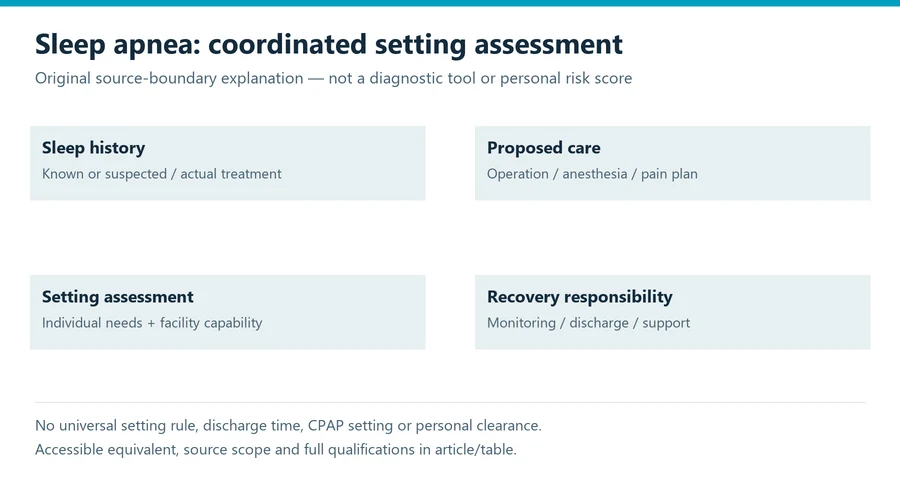
| Question | Useful information | Boundary |
|---|---|---|
| Sleep history | Known diagnosis, suspected symptoms and actual treatment | No home screening diagnosis |
| Proposed care | Operation, anesthesia and pain plan | No universal technique prescription |
| Setting | Facility capability and clinical assessment | Booking is not clearance |
| Recovery | Monitoring, discharge and support responsibility | No fixed universal discharge time |
The map organizes sleep apnea and outpatient surgery without turning the entries into a score. A complete record can still lead to a recommendation for another setting, additional assessment or postponement. The relevant result is the clinician’s individual plan, not a predetermined conclusion that an elective date should be preserved. Unknown information should remain visible and have a named route for clarification.
The original diagram is an explanation with an equivalent text table. It contains no patient outcomes, observed oxygen levels or calculated complication probabilities. It is not a diagnostic pathway or a substitute for clinical monitoring. Use it to separate who supplies the sleep history, who assesses anesthesia and who owns recovery arrangements. That separation is useful when several services are involved, because a general reassurance from one office may not establish that every other part of the actual plan has been assessed.
What if you use CPAP or another prescribed treatment?
NHLBI describes ongoing treatment and follow-up for sleep apnea. Tell the teams what you actually use and ask for procedure-specific instructions. Include difficulties with the prescribed device or treatment, rather than assume the prescription alone establishes effective use. The care team can determine what information and equipment it needs and how treatment fits the operation and recovery plan.
For sleep apnea and outpatient surgery, do not independently change device settings, replace a prescribed treatment or decide that an operation cancels its importance. Ask who will coordinate instructions when the operation affects the area where a device is used. This page gives no pressure setting, mask choice, universal restart time or instruction to use a device in every surgical circumstance. The actual surgical and sleep-care teams must address those details. Preserve their written instructions and the contact for questions so that a last-minute ambiguity does not lead to an improvised plan based on a general source or another patient’s experience.
Read NHLBI’s guidance on ongoing treatment and surgical disclosure.
How do pain medicines enter the assessment?
NHLBI advises telling clinicians about apnea when pain medicines after surgery are planned, because precautions may be needed to protect breathing. The actual regimen and clinical needs matter. This page does not prescribe an analgesic, dose or substitute, and it does not instruct a person to stop a medicine independently. Ask the treating clinicians how the pain plan fits the sleep history and what precautions or observation are appropriate. For preparing a complete supplement disclosure for the care team, see supplements and plastic surgery.
Sleep apnea and outpatient surgery preparation should include all relevant prescribed and nonprescribed products in the history the team requests. If several clinicians provide instructions, ask who resolves an apparent conflict. A product described as natural or familiar should not be assumed irrelevant to anesthesia or recovery. The practical record can identify the medicine, indication, instructions and responsible clinician without inventing a safer regimen. Keep the question about pain control separate from a desire to leave the facility earlier; adequate symptom management and respiratory safety are clinical considerations that a general online timeline cannot balance for you.
Does a fixed discharge time prove readiness?
The ASA guideline acknowledges insufficient evidence for a universal time to discharge increased-risk patients to an unmonitored setting. It emphasizes clinical respiratory assessment rather than a fixed clock time. That distinction means a reservation, facility closing time or transport booking cannot establish that discharge is appropriate. The actual team must evaluate recovery and the relevant risks.
For sleep apnea and outpatient surgery, ask how discharge will be assessed and what happens if the planned same-day arrangements change. This article does not supply an observation duration, home oxygen target or self-test that approves going home. A consumer device reading is not a replacement for the required clinical evaluation. Keep transport flexible enough to follow the actual medical decision and clarify who will explain any changed plan. A longer stay, transfer or further assessment should be understood through the clinical explanation, not assumed to represent either a failure or an optional upgrade because an earlier package described a routine departure time.
What do outpatient arrangements need to establish?
The ASA outpatient-surgery page explains same-day care and practical preparation, including the need to understand anesthesia and recovery arrangements. Ask the actual service about transport, accompanying support and follow-up. A companion can provide practical help, but their presence should not be treated as a substitute for medical monitoring the team considers necessary. Ordinary accommodation and a clinically supervised setting have different roles.
Sleep apnea and outpatient surgery planning should therefore establish who is available, what instructions apply and how concerns reach an appropriate clinician after discharge. The clinical team decides whether the proposed support is sufficient for your situation. This page does not designate a caregiver as a medical observer or certify a hotel, home or recovery residence. If you are traveling, clarify continuity before paying for fixed arrangements. The original planning questions make the dependencies visible; they cannot guarantee that the same-day plan will remain appropriate once the actual assessment and postoperative course are known.
Read the ASA’s outpatient-care preparation information.
What if symptoms or treatment change before surgery?
Communicate a meaningful change to the relevant teams and ask whether the assessment or instructions need updating. A previously agreed plan should not be treated as permanently applicable when the history, operation or treatment has changed. Record what changed and which clinician supplied the revised instructions. Do not infer the effect yourself from a web page or adjust a prescribed treatment merely to preserve the date.
For sleep apnea and outpatient surgery, the useful task is coordinated reassessment. Ask which information should be sent to the anesthesia service, who will review it and when the plan will be confirmed. This article does not diagnose worsening apnea or require cancellation in every changed circumstance. It helps distinguish an actual update from a vague impression that something feels different. If you believe there is a medical emergency, seek emergency care instead of waiting for a scheduling response. A preoperative message is useful communication, but it must not become a reason to postpone needed urgent assessment.
What does a hypothetical two-clinician plan illustrate?
Clarify who owns each instruction
Imagine that a sleep-care clinician supplies treatment information while the surgical service arranges an outpatient procedure. Ask how the anesthesia team will receive and interpret the relevant history and who will issue the actual perioperative instructions. Do not assume that sending a document to one office means every team has reviewed it. This is a hypothetical coordination example, not a report of an actual patient or a finding that a service failed. For preparing an accurate cannabis disclosure for the anesthesia consultation, see cannabis and anesthesia consultation.
For sleep apnea and outpatient surgery, record the information sent, the receiving service and the named responsibility for unresolved questions. Clarify the recovery and discharge plan separately from long-term apnea treatment. If instructions appear inconsistent, request coordination rather than choose the easier one or merge them into a personal regimen. The organizer does not validate a protocol; it makes responsibilities visible. An individualized plan is more useful when the people involved know which decisions they own and the patient can identify the route for clarification.
How can practical commitments remain flexible?
Separate the clinical setting decision from travel, accommodation and transport commitments. Ask when the assessment is expected to be complete and what may change the plan. A reservation can organize logistics, but it cannot supply the clinical information needed for a decision. If the care team recommends another arrangement, clarify what service is being proposed and how practical responsibilities will be coordinated.
For sleep apnea and outpatient surgery, an original planning record can list each dependent arrangement, the responsible person and the unresolved clinical question. It is not a financial guarantee, a carrier policy or evidence that everyone needs an extended stay. Confirm actual terms with the relevant service rather than assume a package includes every changed arrangement. Keep the treating team’s instructions separate from the booking service’s availability. If the operation is postponed for assessment, ask which earlier instructions still apply and who will provide the updated plan. A flexible record helps avoid treating money already spent or a companion’s schedule as proof that same-day care must be appropriate. The setting and discharge decisions remain clinical, even when the logistics were arranged first.
Before a rescheduled visit, confirm which team has the updated records and which instructions are still current. Keep the clinical reason for a change separate from the administrative date. This original coordination step does not establish treatment effectiveness or readiness; it helps ensure that the actual clinicians assess the same current proposal and history.
How should source dates and uncertainty be used?
The NHLBI living-with page was updated January 9, 2025. The official ASA perioperative guideline inspected here was published in February 2014, with a distinct 2013 copyright, and is not described as a newly issued 2026 guideline. The ASA patient pages and these sources were inspected October 12, 2026. Where a current page did not display a clear revision date, retrieval is not used to invent one. No qualified clinical review or exhaustive guideline survey is claimed.
Use sleep apnea and outpatient surgery information to prepare accurate disclosure and a concrete team assessment. Keep diagnosis, actual treatment, procedure, medicines, setting and discharge responsibilities separate. Broader operation context is available through the site’s procedure guides; personal anesthesia and setting decisions need the actual clinicians. A useful plan acknowledges uncertainty and can change when the assessment requires it. It does not promise that a treated diagnosis, short procedure, completed worksheet or elapsed recovery time automatically makes same-day discharge appropriate.
Sources and review scope
Plastic Surgery Editorial Team. Source records checked through October 12, 2026. Review scope: source and editorial checks for general education. No individual clinical assessment is represented.
- ASA sleep apnea and anesthesia. madeforthismoment.asahq.org. Publication/update date not stated. Checked 2026-10-12.
- ASA2014 OSA perioperative guideline. asahq.org. Source date: 2014-02. Checked 2026-10-12.
- NHLBI living with sleep apnea. nhlbi.nih.gov. Source date: 2025-01-09. Checked 2026-10-12.
- ASA outpatient surgery. madeforthismoment.asahq.org. Publication/update date not stated. Checked 2026-10-12.